4.3 Three colors cannot mix all colors
No three paints, with or without white, can mix every color, and they fall far short. Imagine every color a surface could possibly have at one lightness, laid out on the color plane of Section 1.7, with gray at the center and the most vivid colors furthest out. At a middle lightness the best three paints reach about a sixth of that area, and all 26 calibrated paints together reach not quite a quarter. The missing colors are not exotic. They are the scarlet reds, the deep yellows, the vivid greens and the deep blues and violets of single pigments. Lights do better, for reasons given at the end of this lesson, though even they cannot mix every color.
Figure 30 draws the region that three paints and white can reach at three lightnesses, for two choices of the three. The red-yellow-blue set is hansa yellow medium, pyrrole red and ultramarine. The other set is hansa yellow medium, quinacridone magenta and phthalo blue (green shade), a yellow, a magenta and a green-blue, close to the printer’s cyan, magenta and yellow. A search through every set of three from fifteen colorful calibrated paints, looking for the one that reaches the most at a middle lightness, picked this second set itself. Around both lie the region that all 26 calibrated paints reach and the limit of all possible surface colors.
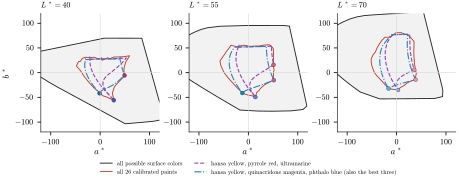
Figure 30. Three paints and white at three lightnesses, seen on the color plane with gray at the center. The outer line is the limit of all possible surface colors [47], the red line the region reached by mixtures of the 26 calibrated paints with white, and the two inner regions what two sets of three paints and white reach: a red-yellow-blue set, and a cyan-magenta-yellow set, which a search at a middle lightness also found to be the best three. The dots are the three paints of each set, brought to the lightness with white where they are darker than it.
The shapes show what is missing. The red-yellow-blue region has no violet corner, because its red and blue mix to gray, and its greens are dull. The cyan-magenta-yellow region has violets and greens, but it loses the oranges and the scarlet reds, which its magenta cannot reach. Both regions have sides that curve inward, because most mixing lines between two paints sag toward gray, and neither fills the region of the 26 paints, which is itself under a quarter of what surfaces can do.
The limit comes from Part 3. At every wavelength a mixture’s \(K/S\) lies between the smallest and the largest of its ingredients’ (Fact 3.2), so a set of paints can never reach a spectrum outside that range. And the way \(K/S\) turns into color bends most mixing lines between colored paints toward gray (Principle 3.1), so where they bend, the region the paints reach is smaller than the straight-sided shape joining their colors. A few lines bow outward instead: those from a yellow to a blue, and those from white to a dark transparent paint, whose tints are more vivid than the paint itself (Section 3.4). How the regions are drawn, and their areas at each lightness, are in the math box at the end of this lesson.
Mixing two lights just adds them, so the mixtures of three lights fill the straight-sided triangle between them on the chromaticity diagram. Even so, no triangle holds every color, because the edge of the diagram, where the single wavelengths lie, curves outward. An ordinary monitor’s three lights enclose about a third of the diagram [78, 36]. Pointer measured the colors of some four thousand real surfaces, and the region he found is still the standard against which displays are judged [61]. Paint is worse off than a display, since its primaries are themselves surfaces and its mixtures bend toward gray.
Sources
[26] H. Grassmann, Zur Theorie der Farbenmischung, Annalen der Physik und Chemie 89 (1853), 69–84.
[36] IEC 61966-2-1:1999, Multimedia systems and equipment. Colour measurement and management. Part 2-1: Colour management. Default RGB colour space: sRGB.
[47] D. L. MacAdam, The theory of the maximum visual efficiency of colored materials, Journal of the Optical Society of America 25 (1935), 249–252; Maximum visual efficiency of colored materials, ibid. 361–367.
[61] M. R. Pointer, The gamut of real surface colours, Color Research and Application 5 (1980), 145–155.
[78] G. Wyszecki and W. S. Stiles, Color Science: Concepts and Methods, Quantitative Data and Formulae, 2nd ed., Wiley, 1982.