3.6 Glazes against tints
A transparent paint can be made lighter in two ways. You can mix it with white, which makes a tint, or you can thin it and lay it over a white ground, which makes a glaze. At the same lightness they do not give the same color. The glaze is far more vivid: at a middle lightness quinacridone magenta has a chroma of 55 as a tint and 87 as a glaze, and burnt sienna’s chroma doubles.
In a tint, the white’s particles turn light back inside the paint layer, including light in the colors the pigment absorbs, and that returned light is exactly what dulls the color (Principle 3.3). In a glaze nothing in the film scatters. Light goes down through the pigment, bounces off the white ground and comes back up through the pigment again. The colors the pigment passes come back nearly whole. The colors it absorbs have to survive two trips through it, and in a thick enough glaze almost none of that light does. A glaze can be made as vivid as the pigment’s own absorption allows, at the cost of lightness, and a tint cannot.
Figure 18(a) follows four paints both ways, three transparent ones and burnt sienna, from the masstone up toward white. Along the tint series the chroma rises to the tint peak and then falls. Along the glaze series, from a thick glaze that is nearly the masstone to a thin wash that is nearly the bare ground, it rises to a higher peak and falls more slowly. From the masstone’s lightness up to a lightness of about 90 the glaze has the higher chroma, by 20 to 35 units in the middle of the range. Panel (b) sets the two side by side at two lightnesses. The hue differs too: the magenta glaze is slightly more violet than the tint, because the glaze lets through the violet the pigment passes, while in the tint the white dilutes it.
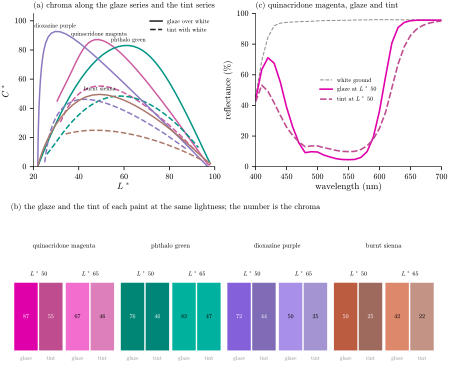
Figure 18. Glazes against tints. (a) Chroma against lightness for three transparent paints and burnt sienna, thinned over a white ground (solid) and mixed with white (dashed), both computed from the same absorption. (b) The glaze and the tint of each paint at lightnesses of 50 and 65, with their chroma. (c) The reflectance of quinacridone magenta as a glaze and as a tint of the same lightness, with the white ground.
Quinacridone magenta, made both ways to the same middle lightness in panel (c), shows where the difference comes from. In the green, which the pigment absorbs, the tint reflects 10 to 14 percent and the glaze only 5 to 10. In the red, which it passes, the glaze is a little the brighter. The extra green light in the tint is the white’s scattering at work, and in the glaze there is nothing to do that work.
The model’s glazes are a little too good. A real glaze film scatters slightly at its pigment particles and where it meets the ground, and Section 2.3 found that following the slanting light properly takes a few units of chroma off them. A thick glaze of a strong pigment is also darker than any tint of it. The gap between glaze and tint is several times larger than those corrections. That gap is the physical content of the old distinction between a glaze and a tint, and the reason the transparent pigments are the glazing colors: quinacridone magenta mixed with white gives a pink, while glazed over white it gives a deeper color, more vivid than any of its tints.
Back to top