1.8 What a gamut is
No set of colorants, lights or inks can make every color. The set of colors a system can make is its gamut, and the gamut of a painter’s palette is the set of colors that can be mixed from it. Gamuts are best pictured one lightness at a time: at a given lightness there is an outer boundary beyond which no surface of any kind can go, a smaller region a monitor can show, and a smaller region still that a given set of paints can reach. Real paints fall well inside the physical limit, and the most vivid of them, the cadmium yellows and oranges, fall outside what a monitor can show, so no picture in these notes, on a screen or printed, can show them as vivid as they are.
The regions are drawn at two lightnesses in Figure 7. The outer line is the physical limit. It belongs to ideal surfaces that reflect all of the light in one band of wavelengths and none outside it, or the reverse. These are called the optimal colors, and they are the most vivid surfaces that could exist at that lightness [47]. The dashed line is what an ordinary monitor can show [36]. The inner solid line is what the 26 calibrated paints can reach by mixing them two at a time and adding white, as the model computes it; the dots are those paints and their tints near that lightness. At a lightness of 75 the yellows go beyond what the monitor can show. At 50, the middle of the scale, the reds and violets are well inside the monitor’s range while the greens and green-blues go beyond it, and at both levels everything the paints reach is far inside the physical limit.
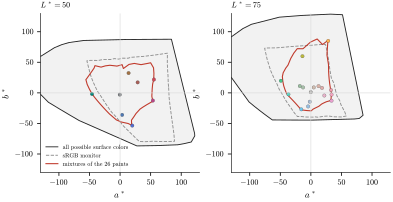
Figure 7. Gamuts at two lightnesses, on the \({a^{*}}{b^{*}}\) plane. The outer line is the limit of all possible surface colors (MacAdam’s optimal colors [47]). The dashed line is the limit of an ordinary sRGB monitor [36]. The inner solid line is the region reached by mixing two of the 26 calibrated Golden paints at a time with white, computed with the mixing model; the dots are those paints and their tints within three units of the lightness.
Real pigments fall short of the physical limit because their absorption does not switch on and off sharply at the edge of a band, and they absorb some of the light they ought to pass. Cadmium yellow medium, the most vivid paint in the Golden set, has a chroma of 98, while the optimal color of the same lightness and hue would have 146. Pointer collected the most vivid real surfaces he could find, of every kind, and his gamut of real surface colors is the usual reference for what paints and dyes have reached [61]; the most vivid modern pigments pass it in a few places.
A monitor’s limit is of a different kind. It makes every color by mixing three fixed lights, and mixtures of three lights can only fill the triangle between them on the chromaticity diagram (Section 1.7). On the color plane of Figure 7, which shows one lightness at a time, the monitor’s range appears instead as the irregular dashed shape. An ordinary monitor misses the most vivid greens, cyans and yellows of real surfaces [36], and twelve of the 78 Golden masstones lie outside its range, among them three of the cadmium yellows, cadmium orange and cobalt teal. Every swatch in these notes has been brought inside the monitor’s range where necessary by reducing its chroma while keeping its lightness and hue, so the pictures understate the chroma of the most vivid paints and never their lightness or their hue.
Sources
[36] IEC 61966-2-1:1999, Multimedia systems and equipment. Colour measurement and management. Part 2-1: Colour management. Default RGB colour space: sRGB.
[47] D. L. MacAdam, The theory of the maximum visual efficiency of colored materials, Journal of the Optical Society of America 25 (1935), 249–252; Maximum visual efficiency of colored materials, ibid. 361–367.
[61] M. R. Pointer, The gamut of real surface colours, Color Research and Application 5 (1980), 145–155.