3.2 Subtractive and additive
There are two simple ways to combine colors. Lights add: shine two lights on one spot and you get the sum of the two. Filters subtract: light passing through two filters in a row keeps only what both let through. Paint mixtures sit somewhere between. Light that enters a mixture bounces from particle to particle, and on the way both pigments absorb some of it, which is the subtracting part. A particle that scatters strongly, though, turns light around before it has gone far, so some light comes back out having met only one pigment, which is the adding part. The more one paint scatters, the more of the light its partner would have absorbed gets sent back out.
So mixtures of opaque paints come out lighter and grayer, closer to an average of the two paints, and mixtures of transparent paints, which scatter almost nothing, come out dark, because whatever either paint absorbs is lost.
A thought experiment shows the range, one that no real pair of paints allows, since no two pigments absorb exactly alike. In Figure 14(a), hansa yellow medium is mixed half and half with an imaginary blue that absorbs exactly like phthalo blue but whose scattering we set by hand. At first it scatters nothing, which makes it a dye dissolved in the binder. Then it is given a few times the scattering of the real phthalo, and then a little more than opaque chromium oxide has. The dashed curve beside each mixture is the plain average of the two paints’ reflectances. That average is what fine dots of the two side by side would give, the fully additive case.
With the dye, the yellow’s red light is simply gone: where the yellow alone reflects most of it, the mixture reflects almost none, and the result is a dark green. As the blue is given more scattering, it grows paler on its own, from black to a pale blue, and the mixture climbs toward the average in the band of wavelengths the blue absorbs. Panel (b) follows this up to a blue that scatters as much as the white. In that band the mixture keeps less than a tenth of the average’s light at the start and more than half at the end. The green turns gray along the way and ends as a dull violet, because a blue that scatters as much as the white is a weak, pale blue, and the mixture is mostly that pale blue with some of the yellow’s red let back in.
Each imaginary blue is really a different paint, since its masstone pales as its scattering grows, so none of this goes against Fact 3.2. A real opaque pigment shows its opacity in its masstone already.
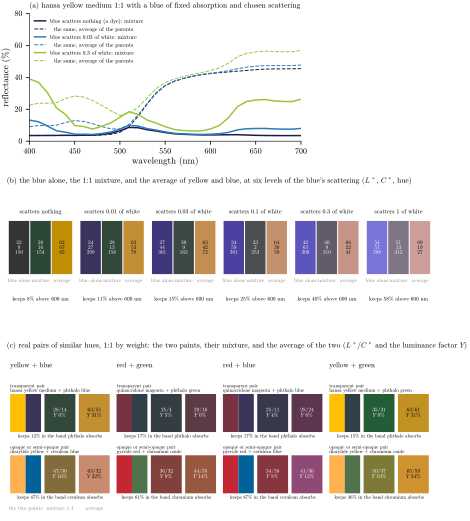
Figure 14. Between subtracting and adding. (a) Hansa yellow medium mixed half and half with an imaginary blue that absorbs like phthalo blue, given three amounts of scattering; the dashed curves are the plain averages of the two paints, the fully additive case. (b) The same at six amounts of scattering: the blue alone, the mixture, the average, and the share of the average’s light the mixture keeps where the blue absorbs. (c) Four real pairs of similar hues, each made once from transparent or semi-transparent paints and once from opaque or semi-opaque ones by Golden’s ratings, half and half by weight, with the same comparison.
Real pairs behave as the thought experiment predicts. Panel (c) takes four pairs of hues and makes each pair twice, once from transparent paints and once from opaque or semi-opaque ones, half and half by weight. Semi-transparent hansa yellow medium with transparent phthalo blue gives a dark green that keeps only about a tenth of the average’s light in the band the phthalo absorbs. Diarylide yellow with cerulean blue, both semi-opaque, keeps nearly half in the band the cerulean absorbs, and makes a lighter green. In all four pairs the opaque version comes several times closer to the average in the band that matters.
How vivid a mixture is, as opposed to how light, depends on what both paints reflect in the colors between them, which Section 3.8 takes up at length. Hansa yellow medium makes a much more vivid orange with semi-opaque pyrrole red than with transparent quinacridone crimson, a chroma of 64 against 46, because the pyrrole red already reflects the orange the mixture needs. Transparent pigments make dark, rich masstones and glazes, but being transparent does not make them cleaner mixers.
The share of the scattering decides how subtractive a mixture is. Take a band where one paint absorbs strongly and its partner hardly absorbs at all. If the partner supplies none of the mixture’s scattering, the band is exactly as dark as in the absorbing paint alone, and the mixing there is fully subtractive. If the partner, or a white in the mix, supplies nearly all of it, the band is nearly as bright as in the partner alone, and the mixing there is additive. In between, the absorbing paint’s K/S in that band counts in proportion to the pigment’s share of the mixture’s scattering: if it supplies a tenth of the scattering, its K/S there is cut to a tenth.
The same rule shows why an opaque blue’s dark band is easier to lift than a transparent blue’s. An opaque pigment’s own scattering already returns some light in the band it absorbs, so its masstone is not black there: in the model, cobalt blue still sends back about an eighth of the red light that gets into it. Phthalo blue sends back only a few percent. Suppose a partner supplies nine tenths of the scattering, which cuts each blue’s K/S in its dark band to a tenth. Cobalt’s band then comes back to a middle tone, nearly half the light, while phthalo’s stays dark. A transparent pigment’s dark band stays dark in any mixture in which it keeps even a tenth of the scattering.
Painting manuals put this in words. Briggs calls paint mixing a combination of subtractive mixing and additive averaging, with opaque pigments leaning toward the second because much of their light is returned by particles of one pigment alone [5]. Berns gives the two-constant law as the form of this in numbers, with the single-constant law, in which the white does all the scattering, as the fully subtractive limit [3], and the paint industry gives every pigment its own absorption and scattering for this reason [39]. Purely subtractive mixing does exist, in filters or glazes laid one over another with nothing scattering between them. A mixture of pigments in paint is never quite that, since even a dye in a white has the white’s scattering to return some of the light.
Optical mixing, dots of two paints too small for the eye to separate, is the fully additive case, and it does not do what the pointillists’ textbooks say either. The eye averages the two reflectances, the dashed curves of panel (a), and since the blues and greens on a palette are dark, the lighter paint dominates the average. Dots of hansa yellow medium and phthalo blue average to a dull yellow, where the stirred mixture of the same two paints is a dark green. Dots of pyrrole red and phthalo green average to a red-brown, where the stirred mixture is nearly gray. From these pairs optical mixing makes neither greens nor grays, only a paler, duller version of the lighter paint.
Sources
[3] R. S. Berns, Billmeyer and Saltzman’s Principles of Color Technology, 4th ed., Wiley, 2019.
[5] D. J. C. Briggs, The Dimensions of Colour: Modern Colour Theory for Traditional and Digital Painting Media, http://www.huevaluechroma.com, 2007–2024.
[39] G. A. Klein, Industrial Color Physics, Springer Series in Optical Sciences 154, Springer, New York, 2010.