4.9 The masstone is not the paint’s color
Color charts, tube labels and most books show a paint by its masstone, the paint straight from the tube in a thick layer, and painters are taught to read a paint’s hue from it. For the dark transparent paints this is wrong, and measurably so. Dioxazine purple in masstone is a near black with the faintest lean toward red, and its tint is a violet. Phthalo green’s masstone has the hue of a blue and its tint the hue of a green. Phthalo blue’s masstone leans toward violet and its tint toward green. These are Okumura’s measurements, not the model’s. A paint whose masstone has a chroma under 10 has no hue a chart can show, and the only honest picture of it is a tint or a glaze.
For thirteen Golden paints, Figure 35 sets the measured masstone beside the lightest step of Okumura’s tint ladder [59]. For the dark transparent paints the hue moves a long way between the two, as much as 57 degrees for dioxazine purple and phthalo blue. Even semi-opaque paints such as pyrrole red and cobalt blue move by 20 degrees or more, for the reasons given in Sections 3.3 and 3.7. Only the opaque, light paints hold their hue: chromium oxide and yellow ochre move by about ten degrees or less.
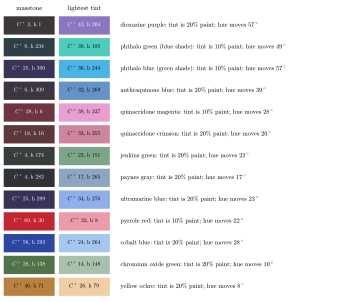
Figure 35. Masstone against tint, measured. For thirteen Golden Matte Fluid paints, the masstone and the lightest step of Okumura’s tint ladder [59], each drawn in its measured color and labeled with its chroma and hue angle, with the distance the hue moves between them.
The masstone hue of a paint with a chroma of 3 or 4 means little. It is the angle of a point lying close to the gray axis, and the instrument places that point only as well as the surface floor allows (Section 2.2). Part 3 compared hues using tints at a fixed lightness for this reason, and a painter who chooses a dark transparent paint by its masstone on a chart is choosing by the wrong number.
The surface floor and the tint peak of Section 3.4 explain the difference together. A dark transparent paint in a thick layer reflects little more than the surface floor at most wavelengths. In the band it passes it differs from a black by a percent or two, and the hue those few percent define is ruled by whichever end of the spectrum leaks most. For the phthalos that is the short-wave end, so their masstone hues lie further round toward blue and violet than their tints’. Adding white lifts the passed band up the steep part of the curve that turns \(K/S\) into reflectance, while the absorbed bands stay down, and only then does the pigment’s real pattern of absorption appear as a color.
Sources
[59] Y. Okumura, Developing a Spectral and Colorimetric Database of Artist Paint Materials, M.S. thesis, Rochester Institute of Technology, 2005, https://repository.rit.edu/theses/4892.