1.1 The light spectrum
Light travels as a wave, and the length of the wave, the distance from one crest to the next, decides what color the light looks when it is seen on its own. Visible wavelengths are tiny, so they are measured in nanometers, millionths of a millimeter. A light source emits a mixture of wavelengths. The eye can see wavelengths from about 380 to about 780 nanometers, with almost all of the useful range between 400 and 700 nanometers, and a single wavelength seen alone has a definite color, running from violet at the short end through blue, green, yellow and orange to red at the long end. Ordinary white light, from the sun or a generic lamp, contains all of them at once but at varying strengths.
A surface changes the mixture by sending back some fraction of the light at each wavelength and absorbing the rest. The curve that gives that fraction for every wavelength is the surface’s reflectance curve. It is the physical fact behind the surface’s color, and the color itself is what the eye makes of the curve. A yellow paint sends back most of the light from the green to the end of the red and absorbs the blue and violet. A blue paint does the reverse.
What reaches the eye depends on the light as well as the paint. At each wavelength the paint sends back its share of whatever arrives, so the same paint sends a different mixture of light to the eye in daylight than under a tungsten bulb. Color scientists describe a light source by how much light it gives at each wavelength, and they call the standard ones, set by the CIE, the international body for color standards, illuminants. Figure 1(b) compares two of them. Daylight is nearly even across the spectrum, while tungsten light is weak in the blue and several times stronger at the red end, so a tungsten-lit room looks orange next to daylight. How the eye still sees a paint as roughly the same color under both is the subject of Section 1.5.
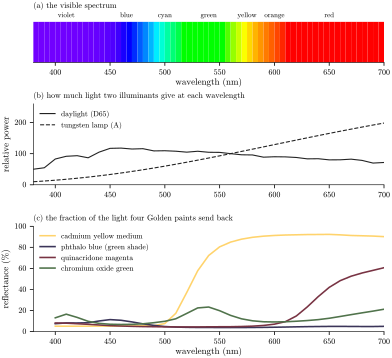
Figure 1. (a) The visible spectrum: the color each wavelength has when it is seen alone, with the usual names of the regions. (b) How much light daylight (the CIE’s standard daylight, D65) and a tungsten illuminant (the CIE’s illuminant A) give at each wavelength, both scaled to 100 at \(560\,\mathrm{nm}\). (c) The reflectance curves of four Golden Heavy Body acrylics, the share of the light each one sends back at each wavelength [24].
The four curves in panel (c) belong to Golden Heavy Body acrylics, measured by Golden on a layer of paint spread over a white card [24]. Painters call paint used straight from the tube, in a layer like this, its masstone, and paint mixed with white a tint. Cadmium yellow medium reflects almost none of the violet and blue light and more than nine tenths of everything from yellow to red. Phthalo blue reflects only about a tenth of the light even at its peak in the blue, so straight from the tube it looks nearly black. Quinacridone magenta reflects the red end strongly and the violet end a little, with very little in between. Chromium oxide green reflects a modest band of green and nearly as much deep red, but the eye is so insensitive to deep red that the red hardly shows.
One detail in these curves matters later. In Golden’s measurements none of the dark paints reads less than about 4 percent at any wavelength, because their instrument collects the light that bounces off the top surface of the paint, before it ever gets in, along with the rest. That surface reflection is much the same at every wavelength, so in these measurements it adds a little of the illuminant’s own light, unchanged, to every color. The light that carries the paint’s color is the part that gets past the surface, into the paint, and back out again (Section 2.2).
Sources
[11] CIE, Colorimetry, 4th ed., CIE 015:2018, Commission Internationale de l’Éclairage, Vienna, 2018.
[24] Golden Artist Colors, Inc., spectral reflectance data for 78 Heavy Body acrylics (10 mil wet drawdowns over a white Leneta card, D65, \(10\degree\) observer, 400–700 nm), published by A. Glassner and E. Haines, Golden Paint Spectra, https://www.realtimerendering.com/golden.html, 2025.
[30] E. Hecht, Optics, 5th ed., Pearson, 2017.
[38] D. B. Judd, D. L. MacAdam and G. Wyszecki, Spectral distribution of typical daylight as a function of correlated color temperature, Journal of the Optical Society of America 54 (1964), 1031–1040.
[78] G. Wyszecki and W. S. Stiles, Color Science: Concepts and Methods, Quantitative Data and Formulae, 2nd ed., Wiley, 1982.