1.4 Metamers
Because the eye reduces every spectrum to three numbers, many different spectra give the same three numbers and look identical. Two surfaces with different reflectance curves that match under one illuminant are called metamers, and a painted copy of a color is almost always a metamer of the original, not a copy with the same curve. The catch is that the match holds only for the illuminant it was made under. Change the illuminant and the two curves are weighted differently, and the match can break. This is why a mixed green that matches a tube green in daylight can part company with it under fluorescent light, and why a color matched in the studio can look wrong in the gallery.
Figure 4 shows such a pair made from Golden paints. The target is chromium oxide green, a single pigment. The match is a mixture of hansa yellow medium, ultramarine blue and titanium white, worked out with the mixing model to look as much like the chromium oxide in daylight as three paints can. The two reflectance curves are plainly different: the mixture reflects more blue-green light and much less deep red. In daylight the two colors differ by about one unit of color difference. One unit is about the smallest difference a careful observer can see with two colors side by side. Under a tungsten illuminant they still match for most purposes, because tungsten light changes smoothly across the spectrum and treats the two curves in much the same way. Under the fluorescent illuminant F11, whose light comes in three narrow bands, they differ by about five units, which anyone can see: the bands happen to fall where the two curves are far apart.
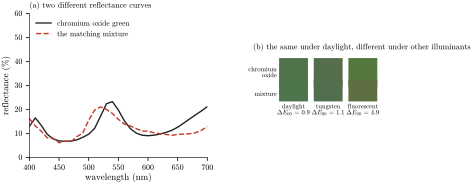
Figure 4. A metameric pair. (a) The reflectance curves of chromium oxide green and of a mixture of hansa yellow medium, ultramarine blue and titanium white chosen to match it in daylight. (b) The two colors in daylight, under a tungsten illuminant and under the narrow-band fluorescent illuminant F11, with the color difference between them under each.
Whether a match survives a change of light depends on how its two curves differ. Where they cross several times and stay close together, the small differences cancel under any light that changes smoothly across the spectrum. The mixture here crosses the chromium oxide curve four times and lies close to it through the blue, and so it survives tungsten well. Two curves that differ in one broad band are more fragile, since any light that is strong in that band will expose them. People differ, too. The eye’s sensitivity varies a little from person to person, with age, the yellowing of the lens and inherited differences in the cones, so a pair that matches for one person may not match for another [20]. This is called observer metamerism. A match is best judged by more than one person for this reason, and the CIE’s standard observer, the set of sensitivities used in every color calculation, is an average over many people.
A mixed match is therefore a metamer of its target, and the wider the range of light it will be seen under, the more it matters that its reflectance curve resembles the target’s as well as its color. A match made with pigments like the target’s, which is to say with a similar curve, is safer than one made with unrelated pigments. Computer matching, in Section 3.11, reports a measure of how far a match drifts under other light, the index of metamerism, alongside the recipe. The exact condition for a match, and how much freedom the curves that share one color have, are in the math box at the end of this lesson.
Sources
[11] CIE, Colorimetry, 4th ed., CIE 015:2018, Commission Internationale de l’Éclairage, Vienna, 2018.
[20] S. S. Deeb, The molecular basis of variation in human color vision, Clinical Genetics 67 (2005), 369–377.
[26] H. Grassmann, Zur Theorie der Farbenmischung, Annalen der Physik und Chemie 89 (1853), 69–84.
[78] G. Wyszecki and W. S. Stiles, Color Science: Concepts and Methods, Quantitative Data and Formulae, 2nd ed., Wiley, 1982.