2.2 The surface
About four percent of the light never gets into the paint. It is the gloss, reflected off the surface of the binder in every paint and at every wavelength, and the rest of these notes call it the surface reflection. On a glossy paint it goes off in one direction as a highlight, and from any other direction the paint shows its own color undiluted. On a matte paint the surface is rough and the surface reflection is spread in all directions, so some of it reaches the eye from every angle and mixes a little white light into the color. Matte paint therefore looks paler and duller than the same paint under gloss varnish, and the difference is largest for the darkest colors. There is a second, less obvious effect inside. Light trying to leave the paint meets the same surface from below, and about sixty percent of it is turned back in, to be absorbed or scattered again, mostly because light that meets the surface at a slant from inside cannot get out at all. Both effects are in every measurement of a paint and have to be allowed for before the paint’s own absorption and scattering can be worked out.
Golden acrylics measured at the Rochester Institute of Technology (RIT), each one bare and under Golden’s matte and gloss varnishes, show the effect of the surface plainly in Figure 9(a); the instrument was placed where the glossy highlight cannot reach it [71]. On the lightness scale, which runs from 0 for black to 100 for white, bone black measures 13 bare, 6 under the gloss varnish and 20 under the matte. The gloss varnish sends the surface reflection off in one direction, away from the viewer, and the black looks blacker; the matte varnish spreads it everywhere and the same black looks gray.
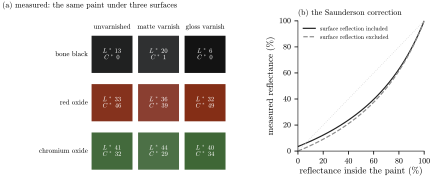
Figure 9. (a) Three Golden acrylics measured bare and under a matte and a gloss varnish, from the RIT Art-SI library [71], with the lightness \({L^{*}}\) and chroma \({C^{*}_{ab}}\) of each swatch. The matte varnish makes every paint lighter and grayer; the gloss makes it darker and richer. (b) What an instrument reads against what the paint sends back from inside, with the surface reflection included (solid) or left out (dashed). The dotted diagonal would be a paint with no surface. The solid line never reaches zero: the surface sets a floor.
The surface also sets a floor under any measurement that collects the surface reflection. The instrument behind the Golden data collects all of the reflected light, highlight included, so no paint can measure below about 3.5 percent there, however black it is, and the darkest paints read about 4. Near that floor a measurement is mostly surface and very little paint, so a near black and a true black read almost the same. Every dark transparent paint in the Golden data sits on this floor over most of the spectrum (Section 2.4), and that is the main reason a masstone measurement of such a paint says so little about it.
Taking the surface back off a measurement is a matter of bookkeeping, which Saunderson worked out in 1942: subtract the light reflected at the top, then allow for the light inside that the surface turns back for another try [64]. Run backward, his formula takes what the instrument reads and gives the reflectance inside the paint, which is what the two laws above describe; Figure 9(b) draws it. The correction is an approximation that works for thick, opaque layers, and it is what the paint industry uses [39, 3]. The math box at the end of this lesson has the formula and the optics behind the four and the sixty percent.
Sources
[3] R. S. Berns, Billmeyer and Saltzman’s Principles of Color Technology, 4th ed., Wiley, 2019.
[30] E. Hecht, Optics, 5th ed., Pearson, 2017.
[39] G. A. Klein, Industrial Color Physics, Springer Series in Optical Sciences 154, Springer, New York, 2010.
[64] J. L. Saunderson, Calculation of the color of pigmented plastics, Journal of the Optical Society of America 32 (1942), 727–736.
[71] L. A. Taplin and R. S. Berns, Art-SI Art Material Library: BYK-mac multi-angle spectral measurements, version 1.2, Munsell Color Science Laboratory, Rochester Institute of Technology, 2011.