3.3 Why red paints turn pink with white
A red paint lightened with white does not stay a lighter red. It turns pink: its hue slides toward magenta, and the more white, the further it slides. The cause is in the red’s own reflectance. A vivid red already reflects nearly all of the light at the long, red end of the spectrum, so white has nothing to add there. White brings back instead the blue and violet light the red had been absorbing, and red light with some blue light in it is what the eye sees as magenta, or, in a pale tint, pink.
Figure 15(a) follows the hue of five reds as titanium white is added. Hue is measured as an angle around the color circle. Zero degrees is a pinkish red, larger angles lean toward orange and then yellow, and angles just below zero, written as the high three hundreds, lean toward magenta. Pyrrole red, an orange-leaning red at 30 degrees in masstone, ends near 4 in a pale tint, which is a rose. Naphthol red and the two quinacridones go past zero into the magentas. Okumura measured real tint ladders of all five, and his measurements agree with the model on the direction of every shift and roughly on its size [59].
Red oxide, an earth red, moves the least, from 36 degrees to 24. Its reflectance does not jump from dark to bright at one wavelength the way pyrrole red’s does. It climbs gradually through the yellow and orange, and white opens that gradual slope about as fast as it opens the blue, so the tint gains yellowish light along with the blue and turns much less.
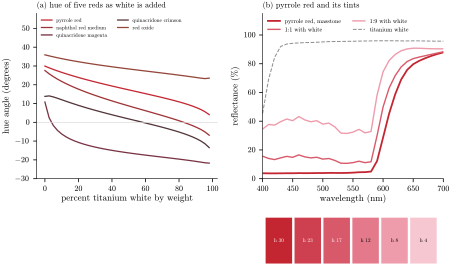
Figure 15. Why reds turn pink. (a) The hue angle of five Golden reds as titanium white is added by weight. (b) The reflectance of pyrrole red in masstone and in two tints, with the white’s own; the swatches along the bottom are the tint ladder, with the hue of each step.
Pyrrole red’s reflectance, in panel (b), shows where the new light comes from. In masstone the paint reflects most of the red light and almost none of the rest, only the few percent of the surface reflection. Mixed half and half with white, its red barely changes, since it was already close to the white’s own level, but its blue and green rise from 4 percent to 13. At one part red to nine of white they reach about a third or more, highest at the blue end. The tint is still a red, since the long wavelengths still dominate, but it is a red with a good deal of blue in it.
On the paint’s side, this is the share-of-scattering rule of Section 3.2 with white as the partner. In the blue, pyrrole red absorbs strongly and, in the model, scatters only about a hundredth as much as the white, and in the green not much more; its scattering rises toward the red, where it reflects. Even at half white nearly all the scattering in the blue comes from the white, and the blue comes back quickly. How little the red scatters in the blue is uncertain (Section 2.6), but scattering that rises toward the red, just past the colors a pigment absorbs, is what colored pigments do (Section 2.4). The white also scatters blue light more strongly than red, which helps.
On the eye’s side, the light the white brings back is blue, violet and some green, most of it at the blue end, with a little orange near the edge of the red’s band. The blue and violet are what the S cones catch, so they feed the blue side of the yellow-blue channel of Section 1.3 and pull the color away from yellow. The green pulls the red-green channel toward green, but the violet and orange light pull it back toward red, so the tint loses its yellowish lean much faster than its redness. A red that leans toward blue is a magenta, or, pale, a pink.
Sources
[59] Y. Okumura, Developing a Spectral and Colorimetric Database of Artist Paint Materials, M.S. thesis, Rochester Institute of Technology, 2005, https://repository.rit.edu/theses/4892.