3.11 Matching colors by computer
The paint industry has matched colors by computer since the 1960s, with the same two-constant law used in these notes. A manufacturer measures each of its pigments in masstone and in tints with white, works out each one’s absorption and scattering at every wavelength, and stores them; the math box at the end of this lesson describes how. To match a target, the software searches for the amounts of three or four pigments that make the mixture’s color equal the target’s under a chosen illuminant, and reports how far the match drifts under other illuminants. A mixture made from different pigments than the target has a different reflectance curve, which makes it a metamer of the target (Section 1.4): a match under one light that can come apart under another. In industry the first batch is then measured and the recipe corrected, and after one or two corrections a match within a unit of color difference is routine [39, 3].
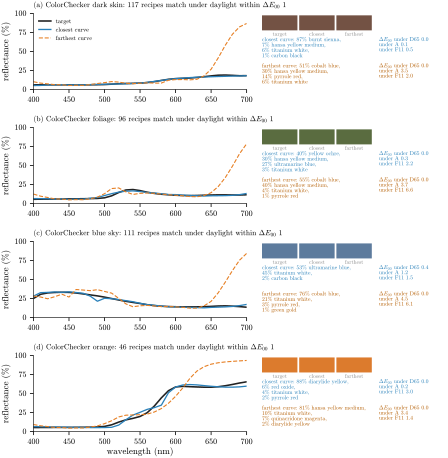
Figure 27. Matching by computer. Four ColorChecker patches matched under daylight with three Golden paints and white. For each patch, of all the recipes that match within one unit of color difference under daylight (D65), the one whose reflectance curve lies closest to the target’s and the one whose curve lies farthest from it, with their color differences from the target under daylight, under a tungsten illuminant (A) and under the fluorescent illuminant F11.
Four patches of the ColorChecker, a chart of colored squares whose reflectances were measured for testing color reproduction, make the test in Figure 27. Each patch is matched with three Golden paints and white under daylight. For the patch called dark skin, more than a hundred different sets of three paints give a match within one unit, about the smallest difference a careful observer can see. They are far from equivalent. The recipe whose reflectance curve lies closest to the target’s is mostly burnt sienna, with a little hansa yellow, white and carbon black, and under a tungsten illuminant or the narrow-band fluorescent F11 it stays within half a unit of the target. The recipe whose curve lies farthest away, cobalt blue with hansa yellow and pyrrole red, matches just as well in daylight but drifts by 3.5 units under tungsten, which anyone would see. This drift under a second illuminant is called the index of metamerism [11], and among recipes that are all perfect in daylight it ranges from invisible to obvious.
The foliage and blue sky patches agree: the recipe nearest the target’s curve drifts less than the one farthest from it. The orange patch is the exception. Its closest recipe, diarylide yellow with a little red oxide and pyrrole red, holds up better under tungsten than hansa yellow with quinacridone magenta, whose curve is farther from the target’s, but worse under F11, the illuminant whose light comes in three narrow bands.
A painter who cannot compute can still use the result. A color matched with pigments like the target’s, which for a skin tone means an earth, holds up better when the light changes than one matched with unrelated pigments, though not under every light, as the orange patch shows.
Sources
[3] R. S. Berns, Billmeyer and Saltzman’s Principles of Color Technology, 4th ed., Wiley, 2019.
[11] CIE, Colorimetry, 4th ed., CIE 015:2018, Commission Internationale de l’Éclairage, Vienna, 2018.
[39] G. A. Klein, Industrial Color Physics, Springer Series in Optical Sciences 154, Springer, New York, 2010.
[51] M. Mohammadi and R. S. Berns, Verification of the Kubelka–Munk Turbid Media Theory for Artist Acrylic Paint, technical report, Munsell Color Science Laboratory, Rochester Institute of Technology, 2004.
[59] Y. Okumura, Developing a Spectral and Colorimetric Database of Artist Paint Materials, M.S. thesis, Rochester Institute of Technology, 2005, https://repository.rit.edu/theses/4892.